
The training is open to graduates of undergraduate programs in Psychology, Psychiatry, Psychological Counseling and Guidance (PDR), Social Work, and Psychiatric Nursing. Priority will be given to candidates who have completed a thesis-based master’s degree in Clinical Psychology.
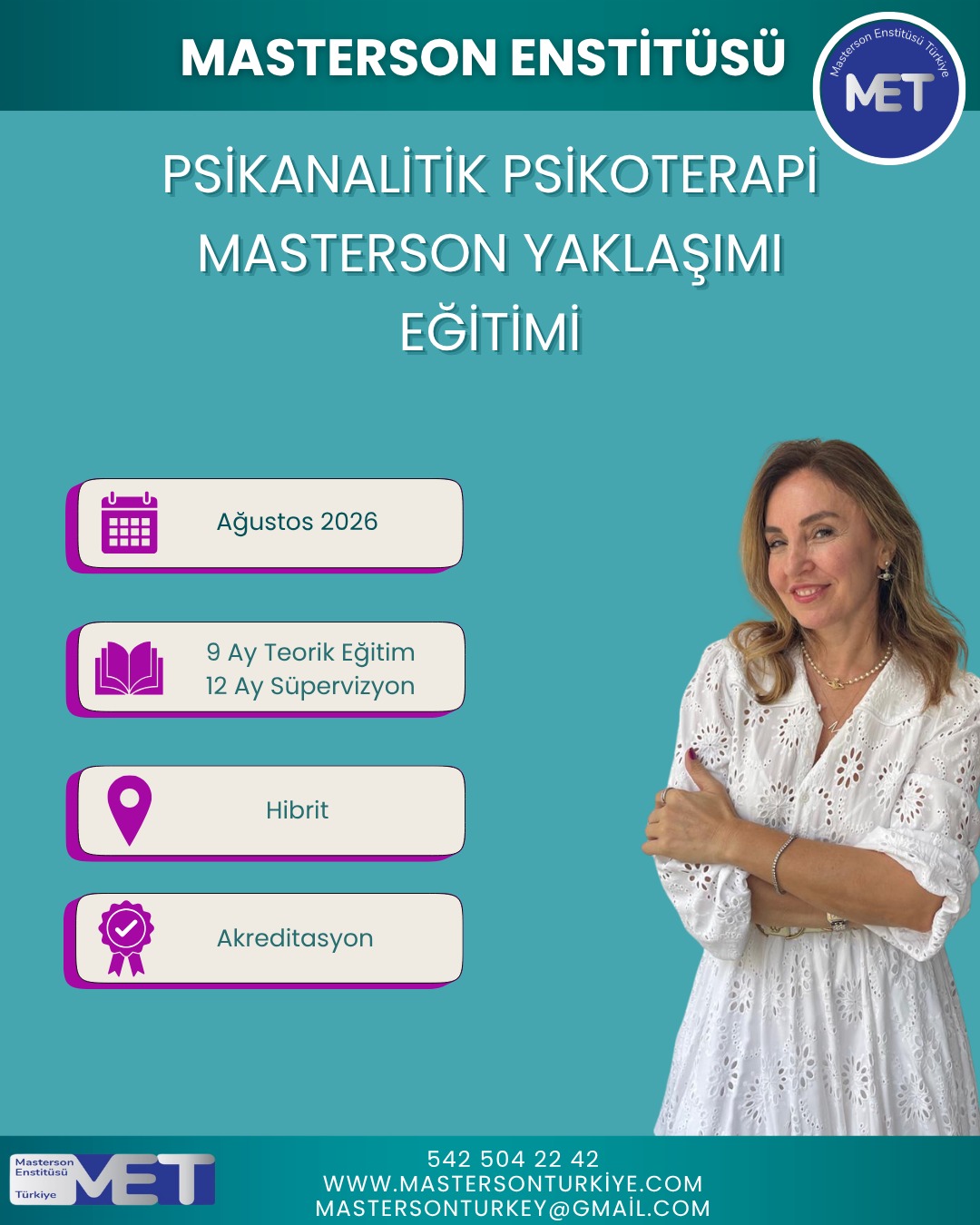
Our training lasts a total of 21 months, consisting of 9 months of theoretical training and 12 months of supervision. Participants who complete the first 9 months of the training will receive a certificate of attendance approved by the International Masterson Institute and Masterson Institute Turkey. To qualify for the certificate of attendance, the maximum allowable absence is 1 month (1 weekend).
After completing the 9-month theoretical phase, participants move on to the second stage, Group Supervision. Group supervision is held one weekend a month (2 full days).
Throughout the supervision process, participants give a 45-minute presentation on a topic of their choice that has been approved. Upon completion of the supervision process, participants who submit a final thesis presenting a case that has not been brought to group supervision become eligible for the Masterson Therapist Certificate.
You can attend the training in person at our Institute center in Nişantaşı, Istanbul, or online via Zoom.
Theoretical Training Dates:
August 29 - 30, 2026
September 26 - 27, 2026
October 24 - 25, 2026
November 28 - 29, 2026
December 26 - 27, 2026
January 30 - 31, 2027
February 27 - 28, 2027
March 27 - 28, 2027
April 24 - 25, 2027
Training Schedule:
Saturday
10:00 - 13:00 First session
13:00 - 14:30 Lunch break
14:30 - 18:00 Second session
Sunday
10:00 - 13:00 First session
13:00 - 14:30 Lunch break
14:30 - 18:00 Second session
The Masterson Approach is a developmental approach that integrates:
· psychoanalytic terminology from Freud to the present day,
· attachment theory,
·object relations theory and neurobiological approaches.
While incorporating all of these, it also offers a structured model.
The Masterson Approach addresses personality disorders within the framework of disorders of the self. Rather than focusing on the pathological personality disorders defined in the DSM-5, it takes a far more comprehensive view, examining disorders of the self under the main headings of Narcissistic, Borderline, and Schizoid Disorders of the Self. Psychoanalytic Psychotherapy: The Masterson Approach makes it possible to work with character structure.
The most important point we wish to emphasize here is that it aims not only at symptomatic improvement but also at structural change. We know that various dimensions of self structures play a role at the root of many symptomatic conditions. Working through pathological development, the Masterson Approach shows the ways in which a healthy Real Self can be established. Affects that have been distorted by defenses come to be genuinely felt and managed. Through this process, it provides a valuable tool for transforming them into vital affects that express themselves spontaneously from our Real Self.

Clinical Psychologist, PhD
No international instructors have been assigned to this training program.
Month 1
Who was James F. Masterson?
The emergence of the Masterson Approach: clinical work and the research process
The stages of the Masterson Approach’s transformation from research into theory; the cornerstones of its theoretical foundation
The International Masterson Institute today and its organization
The integration of developmental approaches, attachment theories, object relations theory, and the neurobiological approach
within the Masterson Approach
What is the self, and what is it not?
On the development of the self and identity: Mahler, Daniel Stern, Bowlby, Ainsworth, Allan Schore,
Winnicott, Melanie Klein
How do disorders of the self develop?
The core defense that keeps the Real Self from emerging: “Abandonment Depression”
Categories of personality disorders as grounded in the Masterson Approach:
-Borderline Disorder of the Self
-Narcissistic Disorder of the Self
-Schizoid Disorder of the Self
How the disorders-of-the-self triad operates
Basing diagnosis and treatment on intrapsychic structure
Determinants of differential diagnosis; the importance of differential diagnosis and of monitoring it throughout treatment
An overview of psychoanalytic terminology:
-Intrapsychic Structure
-Object Relations
-Transference
-Countertransference
-Transference Acting-Out
-Abandonment Depression
-Analytic Neutrality
-Therapeutic Stance
-Therapeutic Frame
Self-activation and the disorders-of-the-self triad
Ego functions and ego defense mechanisms
Projection and projective identification
The interaction between the right brain and mirror neurons
Oscillation between the Real Self and the False Self
The developmental effects of trauma and relational trauma
Psychiatric symptom presentations comorbid with disorders of the self
Borderline Disorder of the Self
The developmental background of Borderline Disorder of the Self and its examination from an object relations perspective
Intrapsychic structure in Borderline Disorder of the Self
Therapeutic interventions in Borderline Disorder of the Self
What the therapist needs to attend to in Borderline Disorder of the Self
The technique of confrontation in Borderline Disorder of the Self
An overview of Transference-Focused Psychotherapy and a comparison
An overview of Marsha Linehan’s Dialectical Behavior Therapy and a comparison
A psychoanalytic decoding of ‘GUILT,’ the emotion that individuals with Borderline Disorder of the Self
find hardest to cope with. How it presents in the therapy room in the Masterson Approach and how it is
addressed in interventions. Guilt in Narcissistic and Schizoid Disorders of the Self.
Addressing self-harm and suicide risk in Borderline Disorder of the Self.
The frame to be established with the families of adolescent clients with Borderline Disorder of the Self
Differential diagnosis and its importance
In particular, the differential diagnosis of the closet narcissistic structure and the borderline structure
Narcissistic Disorder of the Self
The development of healthy narcissism
Intrapsychic structure in Narcissistic Disorder of the Self
An overview of Heinz Kohut’s Self Psychology and a comparison
The unhealthy development of narcissism and the developmental background of Narcissistic Disorder of the Self
Lack of empathy and one-mindedness
A psychoanalytic decoding of ‘SHAME,’ the emotion that individuals with Narcissistic Disorder of the Self
find hardest to cope with; how it presents in the therapy room in the Masterson Approach and how it is
addressed in interventions. Shame in Borderline and Schizoid Disorders of the Self.
Subtypes of Narcissistic Disorder of the Self:
– Exhibitionistic Narcissistic Disorder
– Closet Narcissistic Disorder
– Devaluing Narcissistic Disorder
Preventing ‘dropouts’ in Narcissistic Disorder of the Self structures
Depression, particularly in closet narcissistic structures
The importance of differential diagnosis and differential diagnostic criteria
Schizoid Disorder of the Self
The developmental background of Schizoid Disorder of the Self and its examination from an object relations perspective
Intrapsychic structure in Schizoid Disorder of the Self
Distinguishing Schizoid Disorder of the Self in the Masterson Approach from the DSM-5
diagnostic criteria for Schizoid Personality Disorder
Relational presentations of, and differences between, Asperger’s structures and schizoid structures
Overlaps between anxiety disorders and Schizoid Disorder of the Self
The similar intrapsychic structures and developmental backgrounds of Avoidant Personality Disorder
and Schizoid Disorder of the Self
Common symptomatic presentations of OCD in Schizoid Disorder of the Self and related interventions
‘Relationship’ as a recurring trauma in Schizoid Disorder of the Self
A psychoanalytic decoding of the ‘CONTROL’ that individuals with Schizoid Disorder of the Self need in their relationship with the world
(controlling or being controlled). How it presents in the therapy room in the Masterson Approach
and how it is addressed in interventions. Control in Narcissistic and Schizoid Disorders of the Self.
Subtypes of Schizoid Disorder of the Self:
– Pure Schizoid Disorder of the Self
– Schizoid Disorder of the Self with a Narcissistic Presentation
– Schizoid Disorder of the Self with a Borderline Presentation
Functioning as an object or a robot as opposed to being human
Withdrawing into a safe inner world rather than existing in an unsafe world
The schizoid compromise and the schizoid fantasy
Interpreting the dilemma of trust/mistrust and attachment/non-attachment in therapeutic
intervention in Schizoid Disorder of the Self
Distance as reflected in the session room through transference and countertransference
Establishing a relational psychoanalytic space beyond techniques
Object relations in psychotherapy
Object relations terminology
Psychoanalysis as a Personality System
Defense Mechanisms and Primitive Defense Mechanisms; Melanie Klein: The Schizoid and Depressive Positions
The Infant–Breast Relationship According to Winnicott
Recognizing Reality through the Frustration of Drives and the Formation of the Object; Fairbairn and Object Relations
Mahler and Object Relations
Sense of Identity
The Masterson Approach and Object Relations; Daniel Stern and Object Relations
Bowlby: Object Relations and the Model of the Self; the Concept of the Core Self
Internalized Object Relations
The Formation of Self and Object Representations According to Jacobson
Splitting and Borderline Structure According to Kernberg; the Meanings of Splitting
Object and Self Representations
Clinical Definitions of Self Concepts
How Disorders of the Self Develop
Kohut and Object Relations
The Meaning of the Mechanism of Identification and Mechanisms of Identification According to Hendrick and Koff
The Linking Object According to Vamık Volkan
The therapeutic relationship in object relations: the therapist and splitting, introjection, identification, projection, and projective identification; transference and countertransference in the therapeutic relationship in object relations; therapeutic neutrality
Personality Structures and Object Relations
Stages of the Therapy Process
‘History Taking’ aimed at understanding intrapsychic structure
Establishing the therapeutic frame and structuring sessions
Establishing collaboration (a shared language) suited to the disorder of the self
-The structuring process (differential diagnosis and appropriate intervention)
Ongoing analysis of transference – countertransference processes
Dream analysis and its importance in the therapy process
Relational Overlap
Therapeutic Alliance
Phases of Therapy:
– Testing Phase
– Working Through
– Termination
Group work with case presentations
What Is Neutrality, and Why Is It the Most Fundamental Driver of the Masterson Approach?
Why Can’t the Masterson Approach Be Used as a Module within an Integrative Approach?
The Importance of Language in Psychotherapy and Working with Cultural Factors in Diagnosis and Treatment
Psychopharmacology in Personality Disorders
Axis I, Axis II, Axis III, and Axis IV Assessment in Differential Diagnosis
Group work with case presentations
Developmental Processes in Adolescence
Interaction between the Adolescent, the Family, and the Social Environment
Adolescent–Therapist Session Processes
The Family Interview
Transition to the Individual Process
Providing Ego Support That Offers a Reference to the Self as a Therapeutic Language
Feedback to Institutions and Families
Situations of Self-Harm and Harm to Others in Adolescents
Awareness, Particularly Regarding Educational Processes
The Adolescent’s Self-Perception, Self-Integrity, and Framework of Social Adjustment
A Termination Process That Leads to Adult Communication

