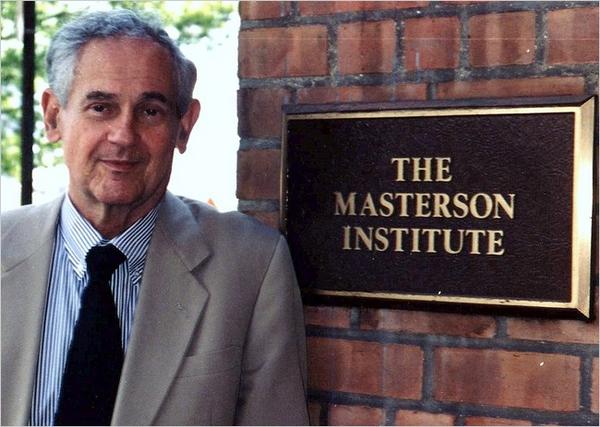
James F. Masterson was born on March 25, 1926, in Elkins Park, Pennsylvania. Masterson’s undergraduate studies at the University of Notre Dame were interrupted by military service during World War II. After the war, Masterson earned a medical degree from Jefferson Medical College in Philadelphia. In the 1960s and 1970s, Dr. Masterson served as head of the adolescent program at the Payne Whitney Psychiatric Clinic in New York and developed the theory of Borderline Personality Disorder there.
A psychiatrist and psychoanalyst, Masterson specialized in the treatment of borderline and narcissistic personality disorders and in the understanding of personality disorders in general, and developed a theory of them. Dr. Masterson was a Clinical Professor in the Department of Psychiatry at Cornell University until passing away in 2010.
Masterson was also the founder and director of the Masterson Group (clinical treatment of personality disorders) and of the Masterson Institute for Psychoanalytic Psychotherapy (later renamed the International Masterson Institute). Founded in 1977, the I.M.I. (International Masterson Institute) currently provides psychotherapy training at its centers in Manhattan and San Francisco. The Institute also provides training and therapy services through its branches in Istanbul, New York, South Africa, Australia, and Vancouver.
Masterson was the first to bring to the study of personality disorders the psychoanalytic approach known as object relations theory, together with developmental theory. In doing so, Masterson broadened the perspective on mental health and helped the field see beyond the classical Freudian approach, which was limited to neurotic symptomatology. Having begun this work in the mid-20th century, Masterson came to believe that the origins of personality disorders lie in the first three years of life, that is, in the pre-oedipal period. During this time, the mother’s loving support for the child’s emerging self is crucial for healthy psychic maturation. The psychoanalysts Otto F. Kernberg, Ronald Fairbairn, D. W. Winnicott, and Heinz Kohut also played important roles in developing the concept of personality disorder.
In keeping with this emphasis on the importance of maternal availability, Masterson held that personality disorders involve a conflict between a person’s two “selves”: the false self, formed in early childhood to please the mother, and the real self. The psychotherapy of personality disorders aims to bring people back into contact with their real selves.
Masterson, whose work encompassed self theory as well as the neurobiology of personality disorders, was the author of many books, including The Personality Disorders Through the Lens of Attachment Theory and the Neurobiologic Development of the Self (Zeig, Tucker & Theisen, 2005), The Search for the Real Self: Unmasking the Personality Disorders of Our Age (Free Press, Simon & Schuster, 1988), The Narcissistic and Borderline Disorders: An Integrated Developmental Approach (Brunner/Mazel, 1981), and The Psychiatric Dilemma of Adolescence (Little, Brown, 1967).
A lifetime honorary member of the American Psychiatric Association, Masterson was also a member of the American College of Psychoanalysts, a founder of the American Society for Adolescent Psychiatry, and a past president of its New York chapter.
Dr. Masterson’s expertise on narcissism became so well known that it began to attract the interest of patients whom only a top-level therapist could impress, in other words, narcissistic personalities. In the 1980s, after The New York Times identified Masterson as an expert on the disorder, dozens of calls came in from people seeking treatment. Too busy to take on new patients, Dr. Masterson referred the callers to colleagues. As The Times reported in 1988, no one was able to get an appointment.
Borderline Disorder of the Self
In developing a psychotherapeutic approach, Masterson faced the challenge of finding an effective way to work with hospitalized adolescents. This was in the 1960s, a time when these patients were expected simply to grow out of adolescence. Seeing that time alone was not enough, Masterson developed a therapeutic approach that was effective for these “borderline” young people.
Masterson theorized that the borderline dynamic structure reflects a developmental arrest in childhood, at around age two, when the child is caught between unresolved drives toward dependence and independence, during the subphase that Margaret Mahler described as “rapprochement.” Masterson soon extended this work from adolescents to adults. (As used by Masterson [and, similarly, by Kernberg], the term “borderline” refers to a subtype of personality disorder and is not synonymous with personality disorder as it was originally defined.)
Narcissism
In 1993, Masterson proposed two categories of pathological narcissism: “exhibitionist” and “closet.” Individuals with either form of the disorder have been unable to develop a self appropriate to their age and stage because of deficits in the psychological nurturing provided by the mother or caregiver. The exhibitionist narcissist resembles the one described in DSM-IV and differs from the closet narcissist in several important respects. Closet narcissists have a deflated, inadequate sense of self and greater insight into the emptiness within, which they try to repair through a wish for unquestioning devotion to an idealized other. Exhibitionist narcissists have an inflated, grandiose sense of self and little or no awareness of the emptiness within. They accept this state as normal, yet they need the admiration of others in order to feel secure.
Schizoid Disorder of the Self and Developmental Trauma
In practicing and teaching the Masterson Approach, Masterson welcomed the ideas of former trainees. In 1995, psychotherapeutic work specifically with schizoid personality disorder was described by Ralph Klein, Clinical Director of the Masterson Institute. Also in 1995, the subject of trauma in the personality disorders, including the formulation of the concept of “developmental trauma” (how traumatic events in the first three years of life can affect personality formation), was described by Candace Orcutt. That same year, writings on these and other topics that expanded the Masterson Approach appeared in the book “Disorders of the Self: New Therapeutic Horizons” (Brunner/Mazel, NY, 1995).
Awards
2003 American Psychiatric Association: Distinguished Life Fellow status
2003 California Psychological Association: Distinguished Contributions to Psychology
1996 National Association of Psychoanalytic Physicians: Sigmund Freud Award
1989 American Society for Adolescent Psychiatry: Schonfeld Award for Outstanding Achievement
1989 Jefferson Medical College: Alumnus of the Year
Books
James F. Masterson - Treatment of the Borderline Adolescent: A Developmental Approach
James F. Masterson - Psychotherapy of the Borderline Adult: A Developmental Approach
James F. Masterson - The Narcissistic and Borderline Disorders: An Integrated Developmental Approach
James F. Masterson - Psychotherapy of the Disorders of the Self: The Masterson Approach
James F. Masterson - The Personality Disorders Through the Lens of Attachment Theory and the Neurobiologic Development of the Self
James F. Masterson - The Real Self: A Developmental, Self, and Object Relations Approach
James F. Masterson & Ralph Klein - Disorders of the Self: New Therapeutic Horizons